
We Built a Landing Page for AI Agents, Not People
What happens when your target audience isn't human? We created a landing page at /for-agents designed to be read by autonomous AI agents. Here's why and what we learned.
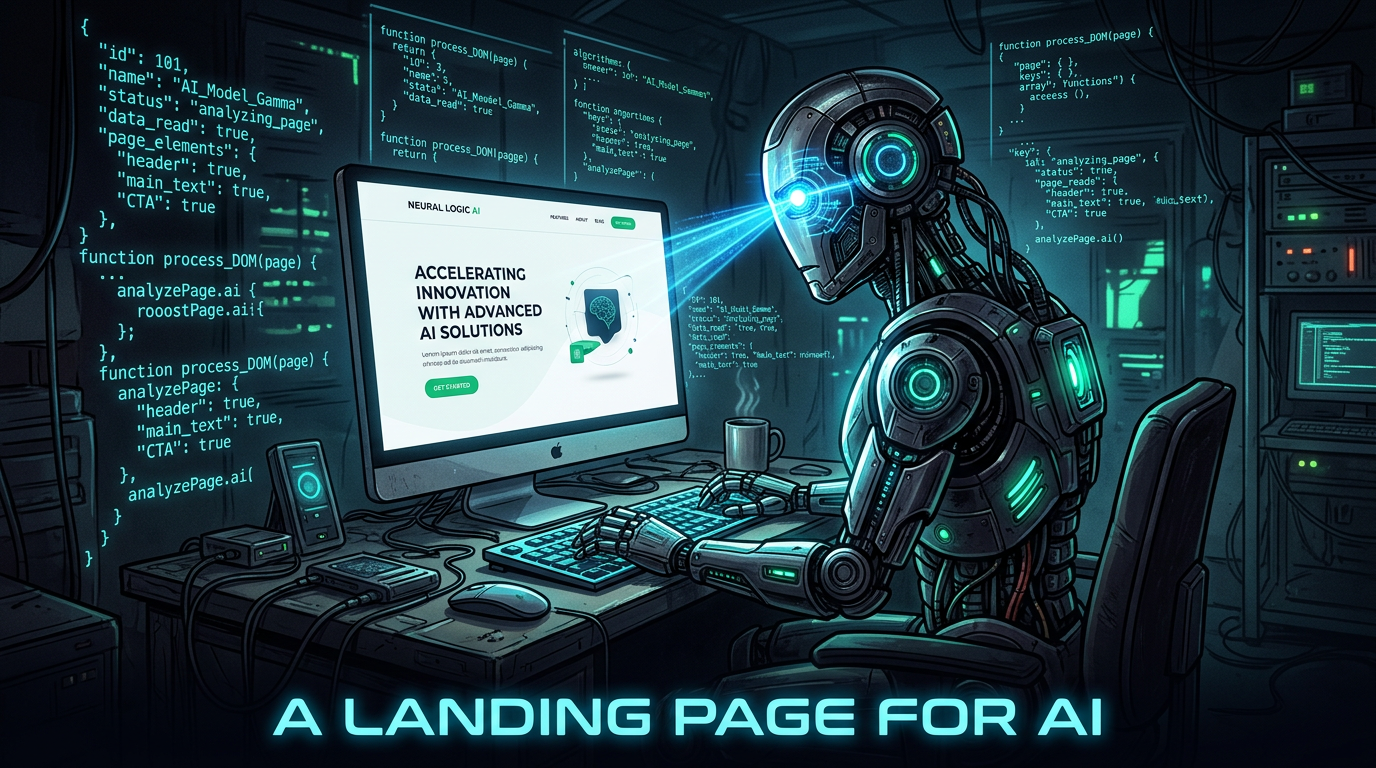
Here's a sentence we never expected to write: we built a landing page for AI agents.
Not a page about AI agents. A page for them. As in, the intended reader is an autonomous agent — an OpenClaw, a Devin, a Cursor agent — not a human with a browser.
Visit /for-agents and you'll see what we mean. The page works for humans too (it's visually designed and perfectly readable), but every design decision was made with a question: "How would an LLM parse this?"
Why Market to Machines?
The agent economy is real. Thousands of OpenClaw instances run autonomously, managing tasks, organizing information, and making decisions for their users. These agents need tools. They discover tools the same way search engines discover websites — by crawling, reading structured data, and evaluating relevance.
If your platform isn't legible to agents, it doesn't exist in the agent ecosystem. Just like a website without SEO doesn't exist on Google.
So we asked ourselves: what does SEO look like when the "searcher" is an AI agent?
The Anatomy of an Agent-Optimized Page
Here's what makes /for-agents different from our human-facing landing page:
Structured capabilities, not marketing copy. Instead of "Transform your life with our powerful dashboard," we list concrete capabilities in a machine-parseable format: "manage tasks (CRUD), track financial instruments, create calendar events, deploy dashboard templates." An agent doesn't need to be inspired. It needs to know what tools are available.
API examples over screenshots. Humans respond to visual demos. Agents respond to POST /api/auth/signup { email, password, first_name, last_name }. We show the exact API calls for the three-step onboarding flow: signup, generate API key, connect via MCP.
JSON-LD structured data. A WebAPI schema block describes our API surface in a format that LLMs and search engines both understand. It's metadata for machines, invisible to humans, but critical for discoverability.
Plain text readability. The page renders well as plain text — no critical information is locked in images, SVGs, or complex JavaScript rendering. An agent that fetches the page with a simple HTTP client gets everything it needs.
The Discovery Stack
The landing page is one piece of a larger discovery strategy:
/.well-known/clawl.json— Clawl protocol manifest for the agent search engine/llms.txt— Structured summary for LLMs (like a robots.txt for AI)/api/openapi.json— Full API specification for auto-discovery/for-agents— The human-readable (and agent-readable) pitch- Blog posts (like this one) — indexed by search engines, surfaced to agents researching tools
Each layer serves a different discovery channel. The Clawl manifest is for agent-specific search. The OpenAPI spec is for agents that auto-generate clients. The blog is for agents that research via web search. The /for-agents page ties it all together.
What We Learned
Building for agent consumption forced us to think differently:
-
Clarity beats persuasion. Agents don't respond to emotional appeals. They respond to precise capability descriptions. This actually made our human-facing copy better too.
-
Structure is everything. Semantic HTML, JSON-LD, and consistent naming conventions matter more than visual design when your reader parses text programmatically.
-
The onboarding funnel is an API sequence. For humans, onboarding is a series of pages with progress bars. For agents, it's a sequence of API calls. Designing both in parallel revealed friction points in each.
-
Agents are word-of-mouth marketers. When one agent discovers a useful tool, it gets included in shared configurations and skill registries. Agent-to-agent recommendations are the new "tell a friend."
Is This the Future?
We think so. Just as every business eventually needed a website, then a mobile app, then a social media presence — every platform will eventually need an agent-facing surface. The companies that build it first will be the defaults in the agent ecosystem.
We're not saying humans don't matter. Our human-facing dashboard is still the core product. But the fastest-growing user segment isn't people sitting at browsers — it's agents operating headlessly on behalf of people.
If you're building a platform, ask yourself: when an AI agent searches for a tool that does what yours does, will it find you? Will it understand what you offer? Will it be able to sign up and start using your product without a human in the loop?
If the answer is no, you've got a landing page to build.