
When Every AI Company Builds Agents: The Integration Problem No One's Solving
OpenAI, Anthropic, Google, xAI, Amazon, Microsoft, Perplexity — they're all building agentic products. They can act. But where do they store the results? The integration problem is the next frontier.
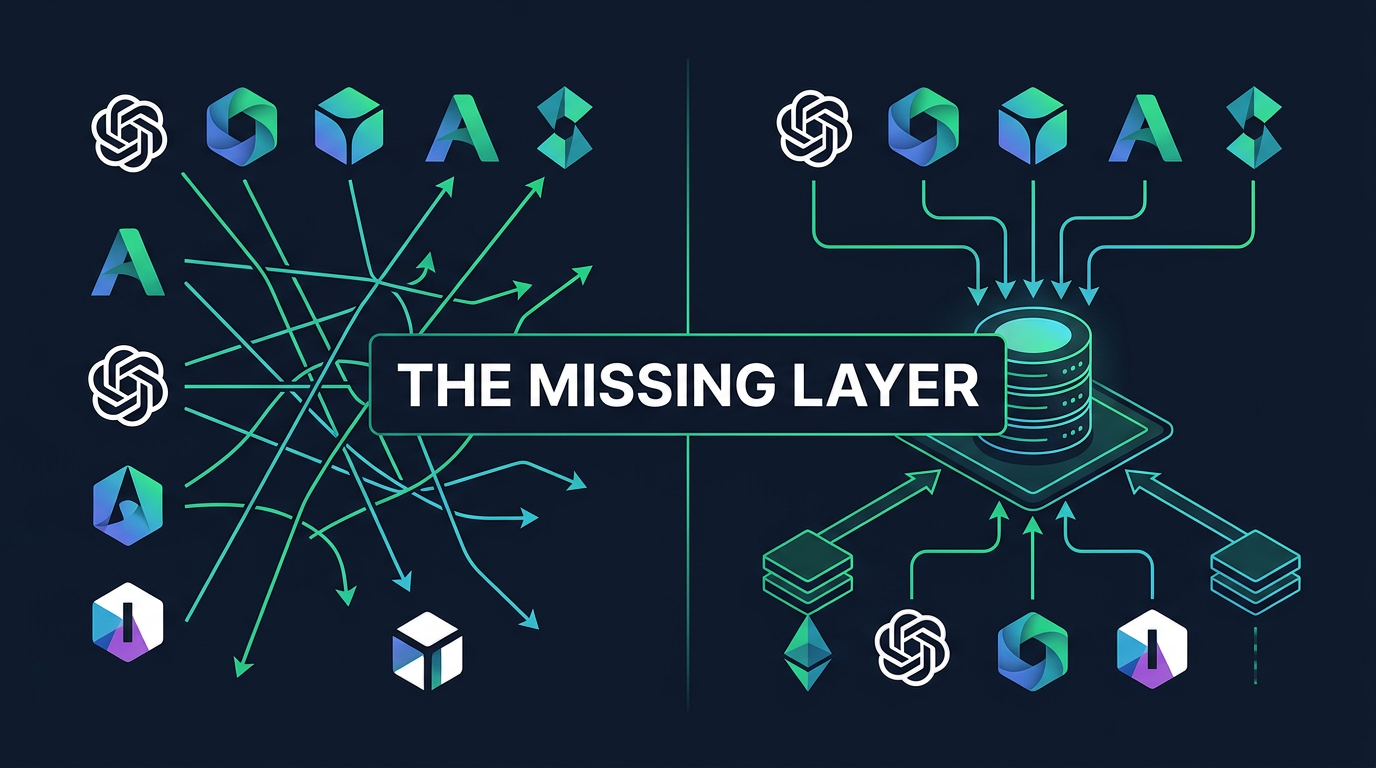
Every major AI company is now shipping agentic products. Not chatbots that suggest — systems that do. Anthropic's Claude Code writes and debugs software. Google's Gemini handles research. Perplexity's Deep Research completes multi-step investigations. OpenAI's new Responses API combines chat with web search, file search, and computer control. Dapr just launched an enterprise framework for running thousands of AI agents on Kubernetes.
The capability race is on. But there's a gap nobody's filling: where do these agents put their output?
The Missing Layer
When an agent completes a task, it produces structured data. A meeting gets scheduled. A task gets created. A reminder gets set. A goal gets updated. That data has to live somewhere. Today, it typically lands in:
- Whatever app the agent was told to use (if it was told)
- A random default (Google Calendar, Notion, etc.)
- Nowhere coherent (the agent "did the thing" but the human has to go find it)
There's no standard. No canonical life-data layer. No platform that says: "Agents, write here. Humans, read here. Everyone, this is the source of truth."
The big AI companies are focused on making agents capable. They're not focused on making agents integrated. That's a different problem. And it's the one that determines whether agentic AI actually improves your life or just creates more scattered output to triage.
What Agents Need
An agent-friendly data layer needs:
- Structured schema — Calendar events, tasks, goals, reminders with consistent fields
- API-first access — REST and MCP so any agent framework can connect
- Authentication — API keys, scopes, revocation — agents operate headlessly
- Transparency — Logs of what each agent did, when, and why
- Human parity — The same data the agent writes is what the human sees in their dashboard
Without this, every agent integration is a one-off. Every company building agents has to build its own calendar, its own task store, its own reminder system — or bolt onto a patchwork of third-party APIs with different auth, different rate limits, different schemas. It doesn't scale.
MyPort.al as the Integration Layer
We built MyPort.al to be that layer. Not an agent — a home for agents. The platform exposes:
- MCP server — Native integration for OpenClaw, Cursor, and any MCP-compatible framework
- REST API — Full CRUD for 40+ module types
- OpenAPI spec — Auto-discovery and client generation
- Webhooks — Event-driven updates so agents don't have to poll
- API keys with scopes — Read, write, MCP — grant exactly what each agent needs
When an agent needs to create a calendar event, it doesn't need to know about Google Calendar's OAuth flow or Notion's API quirks. It calls one endpoint. The data lands in the user's dashboard. The human sees it. The next agent that runs sees it too. One schema. One auth model. One source of truth.
The Next Frontier
The agent capability race will continue. Models will get smarter. Tools will get richer. But capability without integration is capability that doesn't compound. The companies that solve the integration problem — that give agents a coherent place to read and write life data — will unlock the next wave of value.
We're not building the agents. We're building the layer they need to be useful. If you're shipping agentic products, ask yourself: where does your agent put the results? If the answer is "it depends" or "the user figures it out," you've found the integration problem. We're here to solve it.